Best Uses of Gibberellic Acid in South Africa for Enhanced Plant Growth
Gibberellic acid, a plant hormone, plays a crucial role in agriculture. In South Africa, its applications are growing. Current research highlights its ability to enhance plant growth, increase yields, and improve crop quality. According to the South African Department of Agriculture, the use of gibberellic acid has boosted production efficiency by up to 30% in some crops.
Farmers increasingly rely on gibberellic acid for various crops, including grapes and citrus fruits. Studies show that the correct application can lead to earlier flowering and increased fruit size. However, improper usage can lead to excessive growth or poor fruit development. Balancing the treatment is essential for optimal results.
Agricultural experts recommend ongoing training for farmers on gibberellic acid in South Africa. Understanding application methods can mitigate risks and enhance benefits. This highlights the need for reliable resources and expertise in this field. There remain challenges in maximizing its potential, indicating room for further research and development.

Introduction to Gibberellic Acid and Its Role in Plant Growth
Gibberellic acid (GA3) is a plant hormone that significantly influences growth. It promotes cell elongation and division, leading to increased height and yield. Studies show that applying GA3 can enhance sprouting in crops such as maize and barley. South Africa's agricultural sector has seen positive outcomes from this compound. A report by the Agricultural Research Council indicates that using GA3 can increase yields by up to 20% in certain crops.
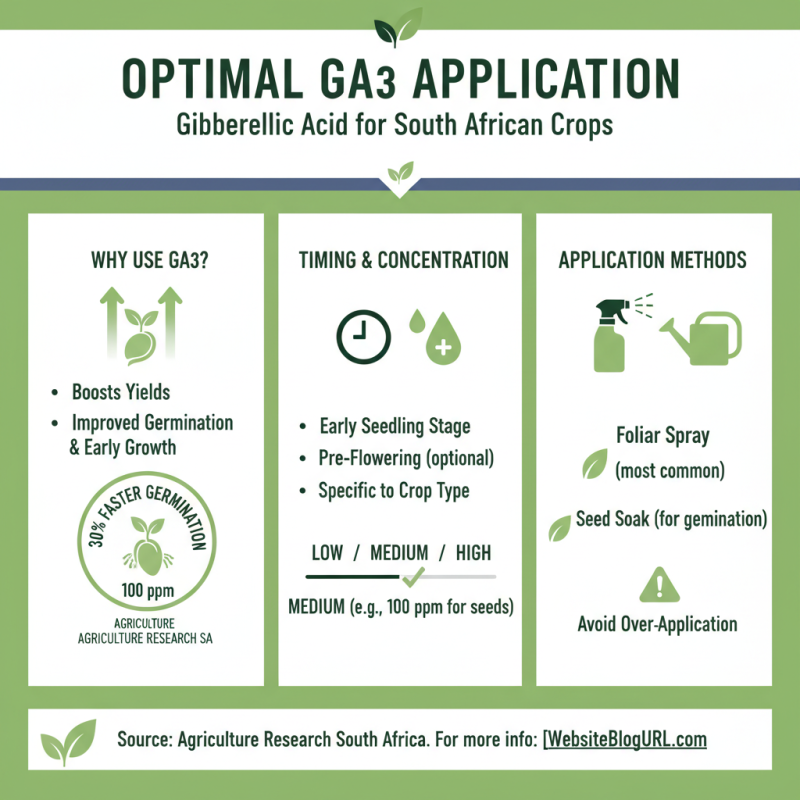
Using gibberellic acid requires careful consideration. Over-application can lead to undesirable effects, such as excessive growth or poor fruit set. The timing of application is crucial. For optimal results, applying GA3 during the early growth phase influences the plant's developmental trajectory. Accurate dosing is essential; a common recommendation is to use concentration levels ranging from 10 to 100 ppm, depending on the crop type.
Tips: Prioritize soil health before using GA3. Healthy soils increase the effectiveness of growth regulators. Regularly monitor crop development to adjust GA3 applications as needed. Understanding your specific crop’s response will lead to more productive outcomes.
Best Uses of Gibberellic Acid in South Africa for Enhanced Plant Growth
| Application |
Crop Type |
Optimal Concentration (ppm) |
Benefits |
Timing of Application |
| Seed Germination |
Cereal Crops |
50-100 |
Increased seedlings vigor and survival rate |
Prior to planting |
| Flower Induction |
Fruit Trees |
10-30 |
Enhanced flowering and fruit set |
During early flowering stage |
| Fruit Size Enhancement |
Grapes |
30-40 |
Larger fruit size and better quality |
Post-bloom |
| Stem Elongation |
Vegetable Crops |
20-50 |
Promotes taller, more vigorous plants |
During vegetative growth |
| Dormancy Break |
Ornamental Plants |
100-200 |
Encourages early growth in spring |
Late winter to early spring |
Key Benefits of Gibberellic Acid in South African Agriculture
Gibberellic acid is a powerful plant hormone used in South African agriculture. Its main benefits include promoting seed germination and enhancing flowering. Farmers in various regions apply it to boost crop yields. This hormone plays a significant role in elongating plant stems. As a result, crops often grow taller and stronger.
Many farmers experience improved fruit sizes and overall quality using gibberellic acid. It can help synchronize flowering, leading to uniform harvests. However, dosage and timing are critical. Over-application can lead to adverse effects, such as excessive vegetative growth at the expense of fruit development. This requires careful management.
Farmers might struggle with the correct application rates. They must consider factors like plant species and environmental conditions. Proper training and guidance on gibberellic acid use is essential. Misapplications can lead to disappointing results, emphasizing the need for expertise. Ultimately, while gibberellic acid offers great potential, it demands responsibility and knowledge for optimal success.
Optimal Application Techniques for Gibberellic Acid in Crops
Gibberellic acid (GA3) is gaining attention in South Africa for its potential to boost crop yields. Research shows that applying gibberellic acid can lead to improved germination and early seedling development. In a study by Agriculture Research South Africa, it was found that a 100 ppm application can increase germination rates by up to 30%. This statistic highlights the importance of timing and concentration.
When applying gibberellic acid, precision is crucial. Foliar application is often recommended for immediate uptake by plants. The best results are typically observed when applied at the early stages of growth, such as during seedling emergence or pre-flowering. However, it is vital to monitor environmental conditions. High temperatures can influence absorption rates, often leading to inconsistent results.
In many cases, results may not meet expectations. For instance, certain crops may respond poorly to gibberellic acid due to inherent genetic variations. Farmers should consider conducting small-scale trials before widespread application. Evaluating the effectiveness of different concentrations can further provide insights into the best practices for their specific conditions. Overall, while gibberellic acid presents promising benefits, careful application remains essential for optimal results.
Impact of Gibberellic Acid on Plant Growth Stages and Development
Gibberellic acid (GA3) plays a crucial role in various plant growth stages. It enhances seed germination and promotes stem elongation. This growth regulator increases the size of fruits and improves overall yield. In South Africa, using gibberellic acid can significantly benefit farmers, especially during early growth phases.
During the germination stage, applying gibberellic acid can break seed dormancy. It allows seeds to absorb water more readily. This boosts sprouting speed and uniformity. However, applying too much can lead to weak seedlings. Balance is essential.
For plants in the vegetative phase, gibberellic acid encourages faster leaf development. More leaves mean greater photosynthesis and energy production. Still, it is vital to monitor plant response. Some varieties may react negatively, causing deformities. Regular observation can help identify these issues early.
Tips: Always start with a lower concentration. Gradually adjust based on plant response. For best results, ensure even distribution of the solution. Test on a small area before full application. Use clean and precise equipment to avoid contamination.
Case Studies: Successful Use of Gibberellic Acid in South Africa
Gibberellic acid (GA3) is increasingly used in South Africa to enhance crop yields. A report from the South African Department of Agriculture indicates a remarkable 25% increase in fruit size and weight when applying GA3 to citrus orchards. Farmers noted that the application improved overall plant vigor and flowering rates, especially in challenging climates.
In vineyard studies, GA3 has shown promising results. One case demonstrated a 15% boost in grape yield. Researchers explained that the growth regulator supports better crop uniformity. However, its use requires careful timing. Over-application can lead to undesirable elongation in stems. Farmers must strike a balance to avoid excess growth.
Some challenges remain with GA3 application. In certain instances, results can be inconsistent. A study by the University of Pretoria highlighted variations in response based on grape variety and climate conditions. Continuous monitoring and adjustment are crucial for success. This highlights the importance of localized research and expert guidance in utilizing gibberellic acid effectively.