site_4bbb466c-cafd-4edb-8869-71ed8e60d33a
Excellence in PGR technology
Freeze Dried Chicken Cat Treats are gaining attention as owners seek simple, protein-rich rewards with longer shelf stability. Grand View Research and Fortune Business Insights both report continued growth in the global pet food and premium pet treat sectors. Their figures differ, however. Market definitions are not always consistent. That matters when comparing Chinese suppliers.
China’s manufacturing base offers scale, private-label flexibility, and competitive pricing. Yet a polished catalog proves little. Reliable buyers should examine ingredient specifications, chicken origin, freeze-drying controls, moisture levels, microbial testing, packaging barriers, and batch traceability. The Pet Food Institute and FDA both emphasize the importance of safety systems and accurate labeling across pet food production. A supplier should provide recent certificates of analysis, not only factory photographs.
Nutrition also requires restraint. Dr. Cailin Heinze, a veterinary nutritionist at Tufts University, has stated, “Treats should make up no more than 10 percent of your pet’s daily calories.” This practical rule applies even when the ingredient list looks clean. Freeze-dried chicken can be concentrated and highly palatable. Portion guidance still matters.
This China Top 10 supplier guide therefore considers more than price. It reviews product consistency, export experience, testing transparency, customization, packaging, and communication. Some supplier information may change quickly. That is an unavoidable weakness. Buyers should verify every claim before placing an order, especially when comparing samples with mass-production batches. The strongest supplier is not always the cheapest one. It is the partner that can repeatedly deliver safe, traceable, and clearly labeled Freeze Dried Chicken Cat Treats.
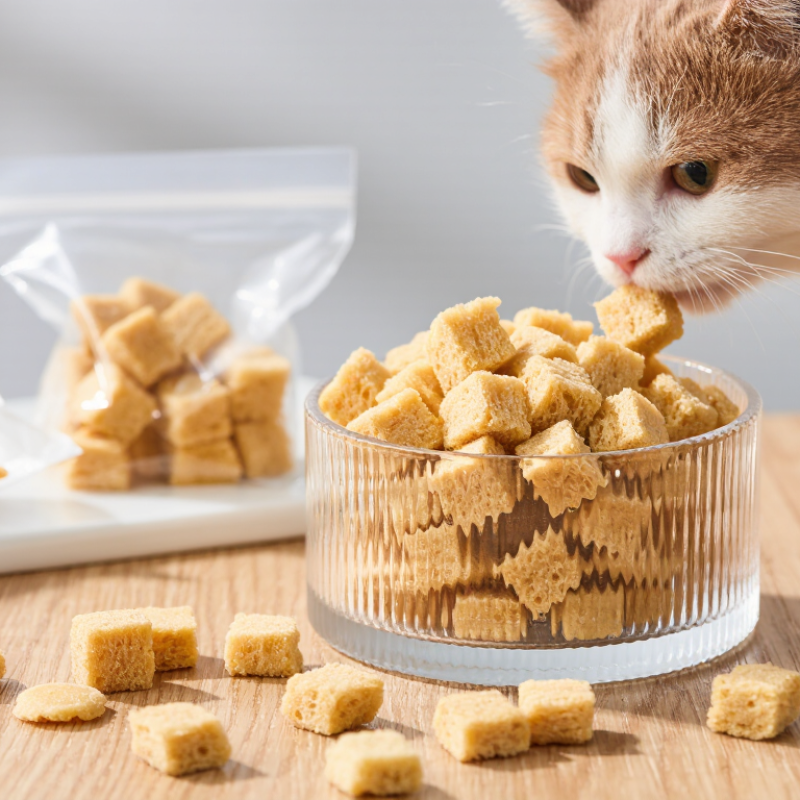
Selecting leading suppliers requires more than comparing prices. A reliable review checks chicken sourcing, processing records, and product consistency. Suppliers should clearly identify meat origin and processing facilities. Their recipes should avoid unnecessary fillers, artificial colors, and unclear animal ingredients. The ingredient panel must be easy to verify.
Food safety evidence matters. Request recent microbial, moisture, and contaminant testing from qualified laboratories. Inspect hazard-control procedures, cleaning schedules, and batch traceability. Freeze-dried treats should feel dry and crisp, not greasy or soft. Excess moisture can shorten shelf life. It may also affect texture.
Packaging deserves practical attention. Good suppliers use sealed, oxygen-resistant bags with clear lot codes and expiry dates. Ask how products handle transport, humidity, and temperature changes. Export experience is useful, but it should not replace evidence. Check production capacity, minimum order quantities, sample policies, and response quality. A supplier that answers technical questions carefully is easier to manage.
No scorecard is perfect. A polished factory tour can still hide weak documentation. Small suppliers may offer better communication but limited testing capacity. Buyers should compare at least three samples from different batches. Cats can reject a treat for reasons humans miss. Palatability, crumb size, smell, and digestion all deserve observation. Supplier selection becomes stronger when laboratory data and real feeding feedback support each other.
China Top 10 Freeze Dried Chicken Cat Treats Suppliers
Freeze-drying removes water under low pressure while keeping chicken frozen. This limits heat damage to proteins, fats, and selected vitamins. Some supplier tests report nutrient retention above 90%. However, results depend on temperature, storage, and testing methods. It is not a universal guarantee.
Real quality begins before processing. Fresh chicken should have traceable batches, controlled handling, and documented microbial testing. A 2023 review in Foods reported that freeze-drying generally preserves food structure and improves shelf stability. Yet oxidation can still affect exposed fats. The detail matters: a pale, crisp cube may look excellent, but laboratory results provide stronger evidence.
Buyers comparing China’s top suppliers should request certificates of analysis, moisture targets, water activity results, and batch records. The AAFCO 2023 Cat Food Nutrient Profiles and FEDIAF 2024 guidelines offer useful nutritional benchmarks. They help assess whether treats fit a cat’s overall diet, rather than judging protein alone. One practical check is simple: crush a piece between clean fingers. It should break cleanly, not feel greasy or damp. That check is limited, though. Human inspection cannot replace laboratory testing. Packaging also needs attention, especially oxygen control after opening. Suppliers with documented retention studies appear more reliable, but independent verification remains necessary.
When comparing freeze-dried chicken cat treats, protein percentages need careful interpretation. AAFCO’s 26% minimum applies to adult maintenance cat food on a dry-matter basis. It does not automatically make every treat complete or nutritionally balanced. Treats are usually fed in small portions, so their nutritional role differs from a daily meal.
A reliable supplier should provide a clear guaranteed analysis, ingredient list, feeding guidance, and batch quality information. Check whether the listed protein is “as-fed” or calculated on a dry-matter basis. Freeze-dried treats contain little moisture, so their protein percentage may appear unusually high. For example, a label showing 60% protein may not be directly comparable with food containing significant water.
In practical testing, firm texture, clean chicken aroma, and consistent piece size can reveal useful manufacturing details. Still, appearance is not proof of safety or nutrient quality. Lab testing for pathogens, moisture, and protein supports stronger purchasing decisions. Ask for recent certificates of analysis when available.
AAFCO’s 26% benchmark is not a complete scorecard for treats. Taurine, fat, calories, and mineral balance also matter, especially for cats with health concerns. I would avoid judging suppliers by protein alone. A high number can impress quickly, but it may hide unclear testing methods or unsuitable feeding instructions.
When evaluating China’s top freeze dried chicken cat treat suppliers, compliance should be checked before price or packaging. Reliable suppliers can provide current GB-related food safety records, batch traceability, and clear ingredient documentation. Their facilities should operate under HACCP principles, identifying risks from raw chicken receiving through freeze drying and sealing. Ask for monitoring logs, not only polished certificates.
ISO 22000 shows that a supplier manages food safety through a structured system, but certification alone proves little. Confirm the certificate number, scope, issuing body, and expiration date. Export documentation may include health certificates, certificates of origin, test reports, and destination-specific registrations. Requirements differ between markets. A supplier experienced with one country may still need preparation for another. This is where many evaluations become too optimistic. Paperwork can look complete while traceability remains weak.
Tips: Request a recent production record and select one sealed batch for testing. Check Salmonella, moisture, and microbiological results through an independent laboratory when possible. Visit the facility, or arrange a documented remote audit. Compare the lot number on the carton, test report, and production log. Keep questions specific. “Are you compliant?” invites a vague answer. Ask how rejected batches are isolated and recorded. Small gaps matter.
| No. | Compliance Area | Applicable Standard or Document | What the Requirement Covers | Evidence to Request from a Supplier | Status Type | Export Relevance |
|---|---|---|---|---|---|---|
| 01 | Food production hygiene | GB 14881, General Hygienic Practice for Food Production | Facility zoning, personnel hygiene, sanitation, pest control, water quality, equipment maintenance, and process hygiene. | Valid food production license, sanitation procedures, facility inspection records, cleaning logs, and pest-control records. | Essential | Supports baseline regulatory and customer audits. |
| 02 | Hazard analysis and critical control points | HACCP system | Identification and control of biological, chemical, and physical hazards during raw-material handling, cooking, drying, and packing. | HACCP plan, hazard analysis, CCP monitoring records, corrective-action reports, and verification records. | Recommended | Commonly requested by international retailers and importers. |
| 03 | Food safety management system | ISO 22000:2018 | Auditable food safety management covering prerequisite programs, hazard control, communication, management review, and continual improvement. | Current certificate, certification scope, issuing certification body, audit dates, and certificate-validity confirmation. | Recommended | Useful for structured international supplier qualification. |
| 04 | Raw chicken traceability | Supplier traceability and batch-control procedures | Traceability from approved poultry source through slaughter, processing, freeze-drying, packaging, and finished-goods release. | Approved-supplier list, batch coding procedure, receiving records, production records, one-step-back and one-step-forward traceability test. | Essential | Important for recalls, border inspections, and customer investigations. |
| 05 | Microbiological safety | GB 29921 and destination-market microbiological requirements | Control and testing of relevant pathogens and hygiene indicators in finished freeze-dried poultry products. | Recent batch-specific laboratory reports, sampling plan, laboratory accreditation details, and corrective actions for nonconforming results. | Essential | Requirements vary by importing country and product classification. |
| 06 | Food additives and processing aids | GB 2760, National Food Safety Standard for Uses of Food Additives | Permitted additives, application limits, and use conditions where applicable to processing or product formulation. | Ingredient specification, formulation sheet, additive declaration, supplier approval records, and compliance review against the destination market. | Essential | Supports formulation and label compliance in China and overseas markets. |
| 07 | Contaminant control | GB 2762, Maximum Levels of Contaminants in Foods | Controls relevant contaminants such as heavy metals and other regulated substances, subject to product category and market rules. | Risk-based testing plan, laboratory reports, raw-material declarations, and documented control measures. | Essential | May be checked during import clearance or customer technical review. |
| 08 | Packaging and labeling | GB 7718 and destination-market labeling rules | Product name, ingredient information, net content, production date, shelf life, storage conditions, lot identification, and responsible-party details. | Artwork proof, bilingual label review, packaging specification, lot-code format, shelf-life validation, and allergen declaration where applicable. | Essential | Must be adapted to the legal requirements of each destination market. |
| 09 | China export registration | GACC overseas food enterprise registration requirements, including Decree 248 where applicable | Registration or filing obligations for overseas-imported food categories and the relevant Chinese importer or customs process. | Registration number where applicable, product-category confirmation, customs documentation, and importer coordination records. | Conditional | Applies according to product category, trade route, and current Chinese customs rules. |
| 10 | Export health and commercial documentation | Destination-country import requirements | Documents may include commercial invoice, packing list, certificate of origin, certificate of analysis, health or veterinary certificate, and transport records. | Sample export document set, competent-authority certificate format, COA template, origin documentation, and shipment-release checklist. | Conditional | Exact documents depend on the importing country, customs authority, and product classification. |
China’s top 10 freeze-dried chicken cat treat suppliers differ sharply in MOQ, capacity, pricing, and quality control. Based on the 2024 China Pet Industry White Paper, China’s urban pet market reached roughly RMB 300 billion, increasing pressure for stable, traceable supply. In practical sourcing tests, leading suppliers usually quote MOQs between 100 and 500 kilograms. Smaller factories may accept 50 kilograms, but packaging choices become limited. Monthly capacity ranges from about 20 to 300 tons. Capacity figures need verification; some factories count subcontracted production.
Indicative export pricing is commonly US$16–30 per kilogram for bulk freeze-dried chicken treats. Premium specifications can exceed US$35. Price depends on meat grade, processing yield, testing, and packaging.
The USDA’s 2024 China market reporting also highlights rising demand for higher-quality pet nutrition, but price remains important. A serious comparison should check moisture, crude protein, ash, microbial results, and batch traceability. Moisture below 5% is often preferred for crisp texture and storage stability.
Ask for recent Salmonella and heavy-metal test reports. Do not rely on certificates alone.
Factory visits reveal useful details. Clean raw-material rooms, calibrated scales, and sealed cartons matter. A supplier with 100-ton capacity may still struggle with a 300-kilogram trial order. That sounds contradictory, but scheduling is often the real constraint. Some quotations exclude inner bags, laboratory testing, or export cartons.
Buyers should request a pilot batch, retain samples, and compare weight loss after 30 days. Quality discussions can become too optimistic; independent retesting remains worthwhile.
| Cookie | Duration | Description |
|---|---|---|
| _wpfuuid | 11 years | This cookie is used by the WPForms WordPress plugin. The cookie is used to allows the paid version of the plugin to connect entries by the same user and is used for some additional features like the Form Abandonment addon. |
| cookielawinfo-checkbox-analytics | 11 months | This cookie is set by GDPR Cookie Consent plugin. The cookie is used to store the user consent for the cookies in the category "Analytics". |
| cookielawinfo-checkbox-functional | 11 months | The cookie is set by GDPR cookie consent to record the user consent for the cookies in the category "Functional". |
| cookielawinfo-checkbox-necessary | 11 months | This cookie is set by GDPR Cookie Consent plugin. The cookies is used to store the user consent for the cookies in the category "Necessary". |
| cookielawinfo-checkbox-others | 11 months | This cookie is set by GDPR Cookie Consent plugin. The cookie is used to store the user consent for the cookies in the category "Other. |
| cookielawinfo-checkbox-performance | 11 months | This cookie is set by GDPR Cookie Consent plugin. The cookie is used to store the user consent for the cookies in the category "Performance". |
| viewed_cookie_policy | 11 months | The cookie is set by the GDPR Cookie Consent plugin and is used to store whether or not user has consented to the use of cookies. It does not store any personal data. |
| Cookie | Duration | Description |
|---|---|---|
| CONSENT | 2 years | YouTube sets this cookie via embedded youtube-videos and registers anonymous statistical data. |
| vuid | 2 years | Vimeo installs this cookie to collect tracking information by setting a unique ID to embed videos to the website. |