7 Best Encapsulated Creatine Monohydrate Manufacturers
The market for Encapsulated Creatine Monohydrate is shaped by a simple expectation: consistent creatine content, dependable quality, and capsules that fit real training routines. The International Society of Sports Nutrition’s 2017 position stand describes creatine monohydrate as one of the most researched and effective supplements for improving high-intensity exercise capacity and lean body mass. The NIH Office of Dietary Supplements also notes potential benefits for repeated bouts of intense activity. These findings explain the ingredient’s popularity, but they do not certify any particular manufacturer.
That distinction matters. A strong supplier should be able to explain its raw-material sourcing, capsule specifications, batch testing, and quality-control procedures. Look for clear documentation, such as a certificate of analysis, and ask whether testing covers identity, purity, and contaminants. A polished website is not proof. Neither is a low quote.
For buyers comparing the seven manufacturers in this guide, the practical details count: capsule size, serving amount, production capacity, lead times, and support for custom packaging. Some suppliers may offer impressive certifications but limited flexibility; others may be responsive yet provide less transparent documentation. There is no perfect checklist. The best fit depends on your market, quality requirements, and order size. Treat performance claims cautiously, verify claims directly with suppliers, and review the evidence before making a decision. This guide uses those criteria to help distinguish established capabilities from sales language. References: Kreider et al., Journal of the International Society of Sports Nutrition, 2017, doi:10.1186/s12970-017-0173-z; NIH Office of Dietary Supplements, Dietary Supplements for Exercise and Athletic Performance.
What Encapsulated Creatine Monohydrate Is and How It Is Manufactured
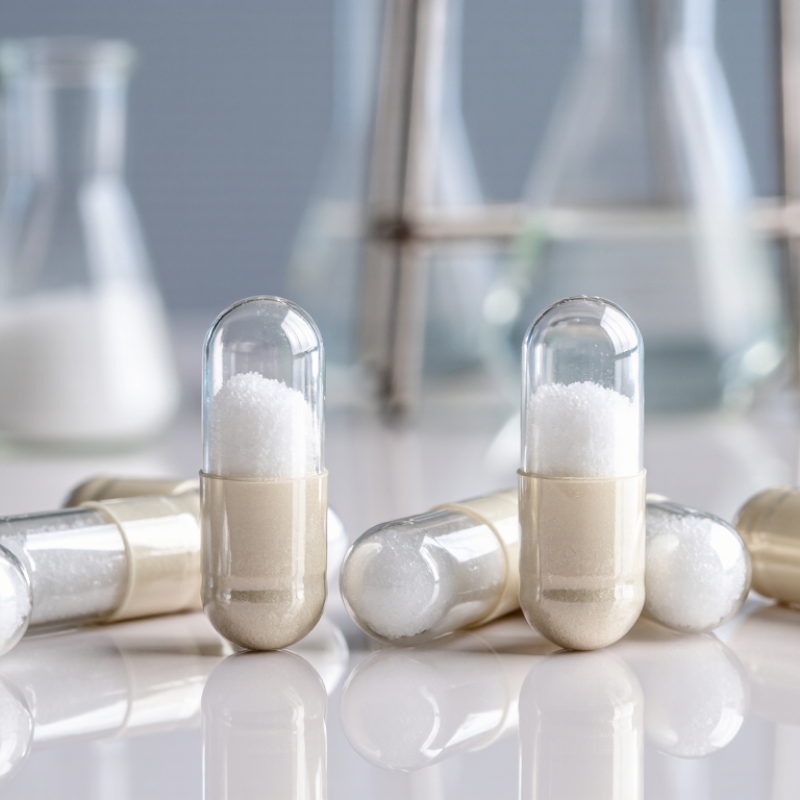
Encapsulated creatine monohydrate is creatine monohydrate powder measured into a swallowable shell, usually gelatin or plant-based cellulose. “Encapsulated” describes the dosage form, not a different type of creatine. The International Society of Sports Nutrition’s 2017 position stand reviewed more than 500 studies and identified monohydrate as the most researched form. That evidence supports careful quality control, not claims that a capsule works better than powder.
Manufacturing begins with verified raw material. Technicians check identity, assay, moisture, and contaminants before blending the powder for consistent filling. A machine doses the blend into capsule halves, joins them, and checks fill weight. Small details matter: damp powder can flow poorly, while uneven filling may create inconsistent doses. The process sounds simple. It is not foolproof.
Quality teams typically test batches for potency, microbial limits, capsule disintegration, and packaging integrity. They also retain samples and document lot numbers for traceability. The U.S. Pharmacopeia’s dietary-supplement standards describe identity, strength, quality, and purity testing as key controls; they do not certify every product automatically. Buyers should therefore look for transparent, batch-specific testing rather than vague “premium quality” language. A capsule can be convenient, but shell materials and serving size may not suit everyone. That trade-off deserves a closer look.
7 Best Encapsulated Creatine Monohydrate Manufacturers - What Encapsulated Creatine Monohydrate Is and How It Is Manufactured | Manufacturer Evaluation Area | Relevant Manufacturing Fact | Evidence to Request When Evaluating a Supplier |
| Creatine monohydrate identity | Creatine monohydrate consists of creatine associated with one molecule of water. Encapsulation adds a coating or carrier around the creatine-containing particles; it does not change the identity of the underlying ingredient. | Ingredient specification, identity test, assay results, and a clear declaration of any coating or carrier ingredients. |
| Incoming raw-material controls | Raw materials should be checked against approved specifications before production. Testing plans commonly address identity, assay, moisture, and relevant contaminant limits. | Current specifications, representative certificates of analysis, supplier qualification procedures, and documented raw-material acceptance criteria. |
| Particle preparation and blending | Particle-size distribution and blend uniformity can affect flow, coating consistency, and the uniformity of the finished product. The appropriate targets depend on the formulation and equipment. | Particle-size test method, blending controls, batch records, and evidence that sampling represents the batch. |
| Encapsulation or coating method | Depending on the formulation, manufacturers may use techniques such as fluid-bed coating or spray-based processes. The method, coating material, and process conditions influence particle properties and should be validated for the product. | Process description, coating-material specifications, validated operating ranges, and finished-particle performance data. |
| Drying, sizing, and handling | After coating, drying and particle-size control may be required. These operations help achieve the target moisture level, flow characteristics, and particle-size range without damaging the coating. | Moisture limits, particle-size results, handling controls, and documented in-process checks. |
| Finished-product quality testing | Testing should confirm that the product meets its specification. Depending on the product and intended market, quality programs may include assay, moisture, microbiological testing, and tests for specified contaminants. | Batch-specific certificates of analysis, validated test methods, laboratory qualifications, and procedures for handling out-of-specification results. |
| Packaging, stability, and traceability | Packaging should be suitable for the product and its storage conditions. Stability studies support the stated shelf life; lot coding and records support traceability through production and distribution. | Packaging specifications, stability data supporting the proposed shelf life, storage instructions, lot traceability, and recall procedures. |
Selection note: This table presents practical manufacturer-evaluation criteria, not a verified ranking of named companies. Encapsulation methods and product performance vary by formulation and process; request product-specific documentation before making a purchasing decision.
How GMP, Third-Party Testing, and Certificates of Analysis Assess Quality
Quality checks matter because creatine monohydrate is widely studied, yet manufacturing controls vary. The International Society of Sports Nutrition’s 2017 position stand reviewed more than 500 creatine studies. That research supports the ingredient’s evidence base, not the quality of any particular batch. Under U.S. FDA 21 CFR Part 111, dietary supplement manufacturers must follow current good manufacturing practices, including production controls and written quality procedures. Ask whether a manufacturer can explain how it verifies identity, potency, and batch consistency.
Third-party testing adds an independent check, but the details matter. Look for a qualified laboratory, preferably accredited to ISO/IEC 17025 for relevant tests. A Certificate of Analysis should identify the tested lot and report results for creatine content and relevant contaminants, such as heavy metals. Check the dates and methods, too. A polished certificate alone proves little if it is generic or does not match the product’s lot number. That gap is easy to miss.
Tip: Request a recent, lot-specific CoA and compare its lot number with the package. Ask what the lab measured and whether results are reported with units and limits. GMP describes a quality system; it does not guarantee every batch is flawless. Independent results help, but they are only as useful as their scope and traceability. Even careful buyers may find reports hard to interpret.
Creatine Dosing in ISSN Guidance: 3–5 g Daily or a 5–7-Day Loading Phase
ISSN guidance describes two common approaches to creatine monohydrate. A loading phase uses about 0.3 grams per kilogram of body weight daily for five to seven days, usually split into four servings. For a 70-kilogram adult, that is roughly 21 grams per day. After loading, a maintenance dose is typically 3–5 grams daily. Smaller servings may be easier on the stomach.
Loading is optional. Taking 3–5 grams daily from the start can also raise muscle creatine stores, though it generally takes longer—around three to four weeks. With capsules, check how many grams each serving provides; the capsule count can be surprisingly high. The arithmetic is less elegant than the label makes it look. Taking the dose consistently matters more than choosing a particular time, and a meal may help if mild stomach discomfort occurs.
Creatine can increase body weight modestly as muscles retain more water. That change may surprise someone tracking the scale, and it is not automatically evidence of fat gain. People with kidney conditions, those taking relevant medications, or anyone unsure whether supplementation suits them should seek advice from a qualified healthcare professional. Follow the product’s serving directions, and avoid treating a loading phase as compulsory.
Seven Encapsulated Creatine Monohydrate Manufacturers Compared
Comparing seven encapsulated creatine monohydrate manufacturers is more useful when the same checks are applied to each. Start with creatine per serving, not capsule count: a serving may require several capsules to reach a practical daily amount. The International Society of Sports Nutrition’s 2017 position stand reports that supplementation can increase muscle creatine stores by about 20–40%, while 3–5 grams daily is a common maintenance approach. Capsules offer convenience, but the serving label deserves a close read.
For each manufacturer, check whether batch-specific certificates of analysis identify creatine content and relevant contaminants. Then compare capsule materials, added ingredients, manufacturing-quality disclosures, and lot traceability. Ask whether testing is conducted by an independent laboratory or only reported by the supplier. Small details matter. A clear assay result is more useful than a broad “purity” claim.
The comparison should also cover capsule breakdown and practical use. A large capsule may be awkward to swallow, and several capsules can make a full serving inconvenient. One weak spot in many comparisons: public product pages rarely provide enough evidence to verify every claim. Treat missing batch records as unknown, not proof of poor quality. ISSN’s position stand supports creatine monohydrate as a well-studied form, but it does not certify individual manufacturers. Manufacturers should therefore be judged on transparent, lot-level evidence rather than marketing language.
7 Best Encapsulated Creatine Monohydrate Manufacturers: Comparison Criteria
This chart shows suggested evaluation weights for comparing manufacturers, not ratings of specific companies. Prioritize verifiable identity and purity testing, manufacturing controls, and accurate capsule dosing when reviewing supplier documentation.
How Capsule Count, Serving Size, and Label Transparency Shape Product Choice
With encapsulated creatine monohydrate, the front label can make comparisons seem simple. Capsule count alone rarely tells the whole story. Check the grams of creatine per serving, then divide by the capsules required. A serving that provides 3 grams in six capsules differs practically from one providing the same amount in three. Small arithmetic matters.
A transparent label should state the creatine amount clearly, define the serving size, and list capsule ingredients, including the capsule shell. Look for batch-specific testing details or a certificate of analysis, and check whether testing covers identity and purity. Vague phrases such as “quality tested” offer little context without naming what was tested. Not always. Testing claims can be difficult to compare, so clear documentation is more useful than polished wording.
Capsule count also affects convenience. More capsules may mean a larger bottle, more frequent restocking, or a serving that feels cumbersome beside a glass of water. Consider the number of servings per container, not just the total capsule count. A low price can look appealing until the serving math is clear. Even careful label comparisons leave trade-offs; capsule size and swallowing comfort are rarely explained well. The best choice is the one whose dose, directions, and testing information are easy to verify.
