2026 Best Uses of Gibberellic Acid in Plants
Gibberellic acid is a plant growth regulator with practical uses across fruit, seed, and ornamental production. The OECD-FAO Agricultural Outlook 2024–2033 projects global agricultural and fish production to grow by about 1.1% annually over the coming decade, largely through productivity gains. That outlook does not measure gibberellic acid use, but it highlights why growers seek precise, reliable ways to manage crop development. The key uses of gibberellic acid in plants include promoting stem elongation, supporting seed germination, influencing flowering, and improving fruit set or size in selected crops. Small doses can matter. Timing matters too.
The response is not universal. A spray that improves fruit size in one crop may have little effect—or an unwanted effect—in another. Crop variety, temperature, application stage, and concentration all influence results. Research on gibberellin biology, including work summarized by plant physiologists Peter Hedden and Valerie Sponsel, explains why this hormone affects such varied growth processes. Yet laboratory knowledge is not a field recipe. That distinction is easy to overlook. This guide examines practical applications, crop-specific considerations, and common limits, while emphasizing label directions and careful observation. The goal is not to promise dramatic results, but to help growers make better-informed decisions. Sometimes the most useful conclusion is that a treatment needs a small-scale trial first.

2026 Overview: GA₃ Chemistry and Its 346.38 g/mol Molecular Weight
Gibberellic acid, or GA₃, has the molecular formula C₁₉H₂₂O₆ and a commonly reported molar mass of 346.38 g/mol. PubChem’s compound record documents its formula and molecular-weight data. The molecule is a diterpenoid plant hormone, not a fertilizer supplying nitrogen or potassium. Small molecule. Big response. GA₃ influences growth signaling, so a small change in plant stage or growing conditions can alter the visible result.
That distinction matters in practical use. Growers may use GA₃ to support stem elongation, fruit development, or dormancy management, depending on crop and label directions. The European Food Safety Authority’s 2012 peer-review report assessed representative uses and residue evidence for gibberellic acid. Its evaluation is a useful reminder that application context matters; molecular weight alone cannot predict crop response. A measured dose, clean water, and consistent timing are more informative than a dramatic claim on a bottle. Yet even careful notes can miss the effects of temperature, cultivar, and plant stress. I would treat each use as crop-specific, and record the growth stage and outcome rather than assume one result will repeat.
2026 Best Uses of Gibberellic Acid in Plants
GA₃ Chemistry and Its 346.38 g/mol Molecular Weight
GA₃ (gibberellic acid) has a molecular weight of 346.38 g/mol. This chart converts example solution concentrations from mg/L to μM using that molecular weight; the values are conversions, not universal application recommendations. Appropriate use depends on the plant species, growth stage, and application method.
How Gibberellins Work: Four Bioactive Forms and Growth Signaling
Gibberellin activity is not one chemical switch.
Plant science reviews identify GA1, GA3, GA4, and GA7 as four major bioactive forms, while their abundance varies by species and tissue (Yamaguchi, 2008, Annual Review of Plant Biology). GA3 is commonly used in horticulture, but similar-looking responses do not make the forms interchangeable.
A young stem may elongate; a dormant seed may begin germinating. Timing matters.
Growth signaling starts when a gibberellin binds the GID1 receptor. The complex helps remove DELLA proteins, which normally restrain growth, through ubiquitination and protein breakdown (Davière and Achard, 2013, Development). In Arabidopsis, five DELLA proteins have been identified, according to Sun’s 2008 Plant Cell review.
A useful detail. It explains why the same treatment can produce different outcomes across crops. For growers, record the crop stage, treatment rate, and visible response, such as stem length or fruit set. Published reviews explain the mechanism, but they do not provide a universal field dose. That gap deserves attention. A plant’s response depends on its genetics, environment, and developmental stage; careful small-scale trials remain more reliable than assuming every crop reacts alike.
Seed and Shoot Uses: Germination, Bolting, and Stem Elongation
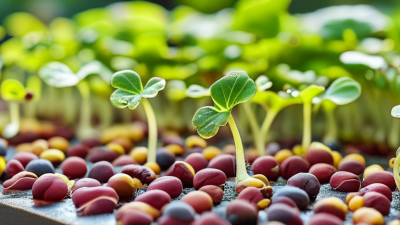
Use gibberellic acid (GA₃) as a growth signal, not a universal seed starter. In responsive seeds, gibberellins help activate enzymes that release stored food for the embryo. This can support germination when dormancy is the limiting factor, but it cannot replace suitable moisture, temperature, or seed quality. Yamaguchi’s 2008 review in Annual Review of Plant Biology describes these hormone-driven growth processes. Responses still vary sharply by species and seed lot.
For shoots, GA₃ can lengthen internodes and encourage bolting in rosette crops such as lettuce. That may help when taller stems are desired, but premature bolting can reduce leaf quality. Too much elongation can also leave stems thin and prone to lodging. Test treated and untreated plants side by side, recording emergence, stem height, and flowering date. The International Seed Testing Association’s 2024 rules commonly use four replicates of 100 seeds for germination tests, subject to species-specific methods. This gives growers a useful comparison framework, not proof that GA₃ caused every difference.
Tips: Start with a small, labeled trial. Keep concentration and timing consistent. The awkward part is that a taller plant can look successful before its weaker stem tells another story.
Fruit Production: Table-Grape GA₃ Programs Commonly Use 10–40 ppm
For table grapes, gibberellic acid (GA₃) programs commonly use 10–40 ppm, but the right rate depends on cultivar, growth stage, and production goal. Around bloom, some growers use GA₃ to lengthen clusters or reduce tightness. After fruit set, applications may support berry enlargement. These are different aims, so timing matters as much as concentration. A rate that suits one block may not suit the next.
Spray when vines are actively growing, and aim for even coverage across the target tissue. Follow the product label and local agricultural guidance; permitted uses and directions can vary by location. Excessive or poorly timed GA₃ may cause uneven sizing, loose clusters, or delayed maturity. Results can be subtle. That part is easy to overlook. Record the cultivar, rate, timing, weather, and response, then compare treated rows with untreated rows where practical. One season rarely tells the whole story.
Tips: Calibrate the sprayer before mixing. Measure ppm carefully, and avoid guessing from an old recipe. Check berries and cluster shape after treatment. If results disappoint, review timing and coverage before increasing the rate.
2026 Best Uses of Gibberellic Acid in Plants - Fruit Production: Table-Grape GA₃ Programs Commonly Use 10–40 ppm
| Program use |
Typical timing |
Illustrative GA₃ concentration |
Intended effect |
Important considerations |
| Berry sizing |
After fruit set, commonly when berries are a few millimeters in diameter |
About 20–40 ppm |
Promote berry enlargement in responsive seedless table-grape cultivars |
Response depends on cultivar, berry size, crop load, coverage, and growing conditions. Excessive rates can cause undersized clusters or uneven berry development. |
| Follow-up berry sizing |
A later post-set treatment, only where supported by local recommendations |
About 10–20 ppm |
Continue berry growth as part of a staged program |
Not every cultivar or vineyard needs a follow-up spray. Consider the previous application, crop condition, and the product label before repeating. |
| Cluster loosening or thinning |
Around bloom, at a locally recommended growth stage |
Often below 10 ppm; rates are cultivar- and label-specific |
Reduce fruit set or improve cluster openness in some cultivars |
This use does not generally fit the 10–40 ppm berry-sizing range. Bloom-stage applications can strongly affect fruit set and require careful local guidance. |
| Cluster elongation |
Before bloom, when recommended for the cultivar |
Often below 10 ppm; rates vary by production system |
Encourage a more open cluster structure in selected cultivars |
Timing is critical. A treatment that is too strong or poorly timed may cause excessive cluster elongation or reduce fruit set. |
| Program planning |
Before each application and throughout the season |
Use the concentration specified for the intended use and product |
Match treatment to cultivar, crop goal, and growth stage |
Concentrations shown are illustrative, not a universal prescription. Follow the registered label and local extension guidance; confirm how ppm is defined and calculated for the product. |
Note: GA₃ response varies substantially among table-grape cultivars and sites. Application timing, permitted uses, and rates differ by jurisdiction and product label.
Application Standards: Check Crop Labels, Timing, and Preharvest Intervals
Gibberellic acid can influence flowering, fruit set, or fruit size, but the right use depends on the crop and product formulation. Check the current label before mixing. Confirm that your crop and intended use are listed, then follow its rate, application method, protective-equipment instructions, and repeat-treatment limits. Timing matters: a treatment at the wrong growth stage may give uneven results. Do not copy rates from a similar crop or an old field note.
Tips: Check the preharvest interval on the label for the exact crop and use. It is the required time between application and harvest. Do not assume another crop’s interval applies. Mark the treatment date on a field record, and leave enough time before picking. A simple calendar reminder helps.
Before spraying, calibrate the equipment and measure the treatment area; small errors can change the dose. Avoid application conditions the label warns against, such as unsuitable weather or crop stress. Follow any stated limits on water volume and application timing. If the label does not clearly cover your situation, pause and ask a qualified local crop adviser or regulatory authority. Even careful planning can miss a detail, so recheck the label at mixing time—not just when the container arrives.